
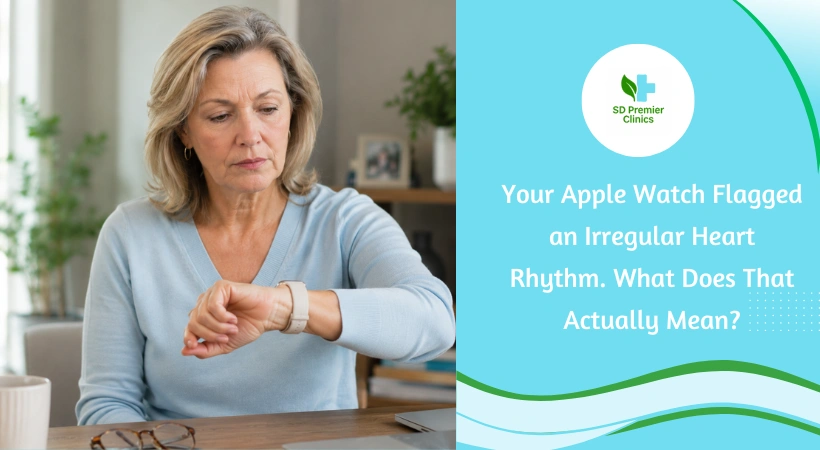
Apple Watch irregular rhythm alerts have become one of the more common reasons people schedule a cardiology appointment, and one of the more common sources of unnecessary anxiety when they don't. The alert means the watch picked up something worth looking at. It doesn't mean you have a heart condition, and it doesn't mean you can ignore it either.
What it actually means depends on the context your watch doesn't have access to.
Here's what the alert is based on, where the technology's limits are, and what a cardiology follow-up involves.
How Your Apple Watch Picks Up Heart Rhythm Changes
The Apple Watch uses two different methods to monitor your heart. The optical sensor on the back of the watch shines light through your skin to measure blood flow and detect your pulse. The ECG feature, available on Series 4 and later, uses electrodes built into the watch face and band to record the electrical activity of your heart, producing a single-lead reading similar in concept to what a doctor's office uses, though much more limited in scope.
The irregular rhythm notification is specifically tied to atrial fibrillation (AFib) detection. When the watch picks up a pulse pattern that looks inconsistent over a period of time, it flags it. What it's not doing is running a full cardiac workup; it's detecting a signal that may warrant further investigation, not identifying what's actually causing it.
What an Irregular Heart Rhythm Actually Is
An arrhythmia is any disruption to the heart's normal electrical pattern,/ too fast, too slow, or simply out of rhythm. There are several types, and they vary considerably in how significant they are:
- Atrial fibrillation (AFib): The most clinically significant type the watch screens for; involves chaotic electrical activity in the upper chambers of the heart
- Premature beats: Early contractions that feel like a flutter or skip; often benign and extremely common
- Supraventricular tachycardia (SVT): Episodes of rapid heart rate originating above the ventricles; usually not life-threatening but worth evaluating
The important thing to understand is that not every irregular rhythm is dangerous, but none of them should be dismissed without a clinical opinion. Many people walk around with occasional benign irregularities they've never noticed. The difference is that your watch noticed this one.
What the Apple Watch Can and Can't Tell You
Understanding the limits of the technology matters here, because the alert means something specific, and it also doesn't mean several things people assume it does.
What it can do:
- Flag a possible irregular rhythm during passive monitoring
- Prompt you to take a single-lead ECG reading on demand
- Store that recording for you to share with a cardiologist
- Raise a flag early, before symptoms develop
What it can't do:
- Confirm a diagnosis of AFib or any other arrhythmia
- Identify the specific type or cause of the irregularity
- Account for your broader cardiac health, medications, or history
- Replace the 12-lead EKG and clinical evaluation a cardiologist uses
A positive alert doesn't mean you have AFib. A negative result doesn't mean your heart is fine. Other wearables, such as Fitbit, Samsung Galaxy Watch, and Garmin, offer similar rhythm monitoring features with similar limitations. They're screening tools, and screening tools exist to tell you when to look further, not to provide the answer themselves.
Should You Be Worried?
The honest answer is: take it seriously, but don't panic. The alert is a prompt to follow up, not a cause for alarm on its own.
A few factors that raise the clinical concern level:
- The alert has appeared more than once
- You experienced symptoms around the time of the alert, such as palpitations, shortness of breath, dizziness, or chest discomfort
- You have a personal or family history of heart disease or arrhythmia
- You're over 65, or have risk factors like hypertension, diabetes, or obesity
Factors that may point toward a more benign cause:
- It was a one-time alert with no accompanying symptoms
- The alert came during or immediately after exercise
- You'd had significant caffeine or alcohol beforehand
- The watch was worn loosely or shifted position during the recording
None of these factors settle the question definitively; that's what a cardiologist is for. But they're useful context for the conversation.
What a Cardiology Evaluation Actually Looks Like
A lot of people put off following up because they're not sure what seeing a cardiologist actually involves, or they assume it'll be complicated. It usually isn't.
At an initial evaluation, your cardiologist will typically:
- Review the ECG recording your watch captured
- Perform a standard 12-lead EKG in the office, which gives a much more complete picture of your heart's electrical activity
- Go through your symptoms, medical history, and any relevant risk factors
If more information is needed, additional testing may include:
- Holter monitor: A wearable device worn for 24 to 48 hours (or longer) that continuously records your heart rhythm to catch irregularities that come and go
- Echocardiogram: An ultrasound of the heart to assess its structure and function
- Further workup depending on what the initial evaluation shows
These are non-invasive, straightforward tests. The goal is to either rule out something significant or catch it early enough to manage it well, and the data your watch captured can actually be a useful starting point for that conversation.
If It Does Turn Out to Be AFib
AFib is the most common heart arrhythmia, affecting millions of people. It occurs when the electrical signals in the upper chambers of the heart fire chaotically rather than in a coordinated pattern, causing an irregular and often rapid heartbeat. Left unaddressed, it raises the risk of stroke and can gradually affect heart function, which is why early detection matters.
That said, AFib is manageable. Many people live full, active lives with it once it's properly diagnosed and treated. Depending on your situation, your cardiologist may recommend:
- Lifestyle modifications (reducing alcohol, improving sleep, managing stress)
- Rate or rhythm control medications
- Blood thinners to reduce stroke risk
- Cardioversion to restore normal rhythm
- Catheter ablation for cases that don't respond to medication
The treatment path depends on the type of AFib, how long it's been present, and your overall cardiac health. The point is that there are good options, and catching it before it causes symptoms is genuinely better than finding out after it does.
An Alert on Your Wrist Is a Signal, Not a Sentence
Your Apple Watch isn't diagnosing you. What it's doing is flagging something it detected and handing the question off to you. A cardiologist is the one who can actually answer it, with a proper EKG, a clinical evaluation, and context your watch simply doesn't have access to.
If you got an alert, the right move is to follow up. Not urgently in most cases, but soon, and with someone who can look at the full picture rather than a single-lead reading taken mid-afternoon.
Get Your Heart Rhythm Checked at SD Premier Clinics
If your Apple Watch flagged an irregular heart rhythm, the cardiology team at SD Premier Clinics can help you find out what it actually means. With in-house EKG testing and prompt appointments, typically within one to two weeks, you won't be left waiting for answers. Bring your watch data, your questions, and your history. We'll take it from there.
Frequently Asked Questions About Apple Watch Heart Rhythm Alerts
1. Can the Apple Watch actually diagnose AFib?
No, it can only flag a possible irregular rhythm; a cardiologist confirms the diagnosis.
2. What should I do immediately after getting an irregular rhythm alert?
Note any symptoms and schedule a cardiology follow-up as soon as possible.
3. How accurate is the Apple Watch ECG feature?
Reasonably accurate for AFib screening, but it's a screening tool, not a diagnostic device.
4. Can stress or exercise trigger a false irregular rhythm alert?
Yes, caffeine, alcohol, intense exercise, and stress can all trigger false alerts.
5. Do I need to go to the ER if my Apple Watch detects an irregular rhythm?
Only if you have chest pain, fainting, or severe shortness of breath; otherwise, schedule a cardiology appointment.
6. Will my cardiologist ask to see my Apple Watch data?
Yes, have your ECG recording accessible when you come in.
More Resources: