


If your doctor has ordered an echocardiogram, it is normal to feel a little nervous about a test you may not be familiar with. The good news is that an echocardiogram is a common heart test that is noninvasive, generally painless, and straightforward.
An echocardiogram is a type of heart ultrasound that uses sound waves to create moving pictures of the heart. It can show the heart's structure, valves, blood flow, and how well the heart pumps blood.
Your doctor or cardiologist may recommend an echocardiogram if you have symptoms that could be related to a heart problem, if another test shows something that needs a closer look, or if you already have a heart condition that needs to be monitored. A standard echocardiogram is generally painless and involves no radiation.
Why Would a Doctor Order an Echocardiogram?
An echocardiogram is a common test used to check the heart's structure and how well it works. The need for this test depends on your symptoms, medical history, physical examination, and other test results.
For example, an echocardiogram may be recommended if you have shortness of breath, chest discomfort, fatigue, or swelling. It may also be used when a heart murmur is found or when there is concern about a heart condition.
Common Reasons for an Echocardiogram
An echocardiogram may be used when evaluating:
- Shortness of breath
- Chest discomfort
- Fatigue
- Swelling
- Heart murmur
- Suspected heart failure
- Heart valve problems
- Cardiomyopathy
- Known heart disease that needs monitoring
- In some cases, heart palpitations when there is a reason to check the heart's structure or function
Having one of these symptoms does not necessarily mean you need an echocardiogram. The test is recommended based on the overall picture.
What Does an Echocardiogram Show?
An echocardiogram creates moving pictures of the heart as it beats. It can show the size and shape of the heart chambers, how the heart muscle moves, and how well the heart pumps blood.
It can also show the heart valves and blood flow through the heart. An echocardiogram may help identify problems such as reduced heart pumping function, heart valve disease, cardiomyopathy, changes in the heart's structure, or fluid around the heart. It can also sometimes show blood clots or unusual growths, although these are uncommon findings.
What Is Ejection Fraction?
Ejection fraction (EF) is the percentage of blood that the left ventricle pumps out with each heartbeat. It is one way to measure how well the heart is pumping.
For many adults, an EF of about 55% to 70% is generally considered normal. However, EF is only one part of an echocardiogram. The other findings, along with your symptoms and medical history, also matter.
What to Expect During an In-Office Echocardiogram in San Diego and El Centro
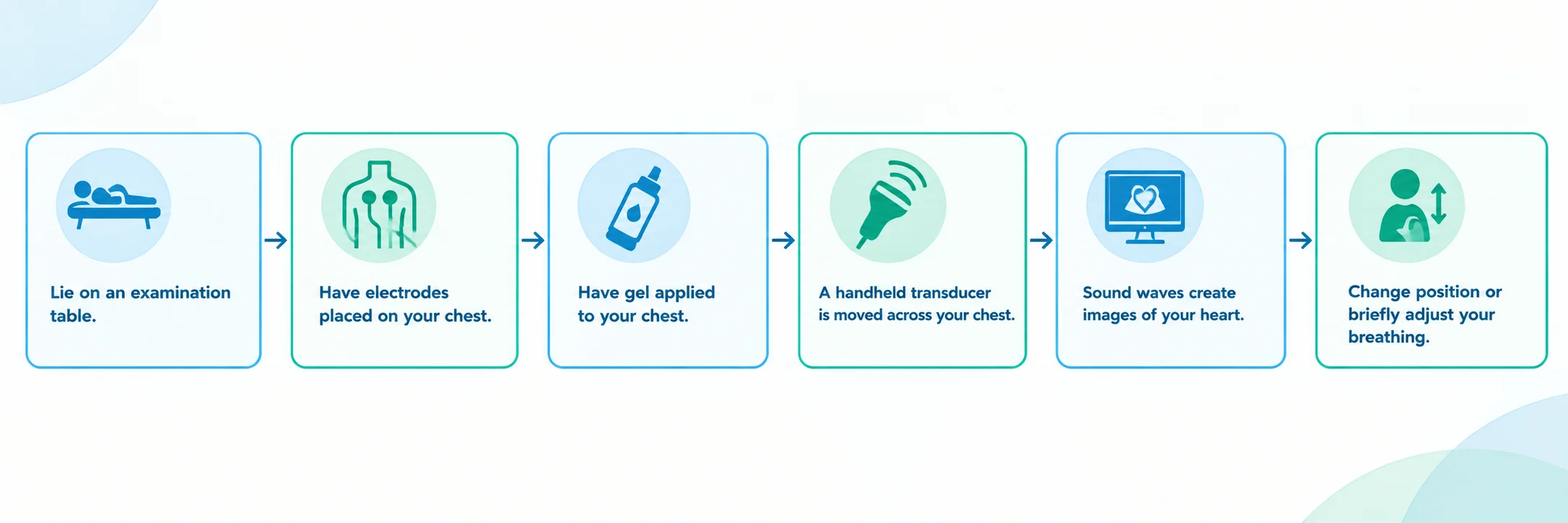
An echocardiogram is a straightforward, noninvasive test. During the appointment, you can generally expect the following:
- You will lie on an examination table. You may be asked to lie on your back or left side.
- Electrodes may be placed on your chest. These can help monitor your heart activity during the test.
- Gel will be placed on your chest. The gel helps the ultrasound waves travel between your skin and the handheld device.
- A handheld transducer will be moved across your chest. The technologist uses it to capture pictures of your heart from different angles.
- Sound waves create pictures of your heart. The device sends sound waves into your chest and uses the returning waves to create images of your heart.
- You may be asked to change position or briefly adjust your breathing. This can help obtain clearer pictures of different parts of the heart.
The test typically takes about 30 to 45 minutes.
Does an Echocardiogram Hurt?
A standard echocardiogram is generally painless. You may feel some pressure as the transducer is moved or pressed against your chest to get clear images. The test uses ultrasound and involves no radiation.
Do You Need to Prepare for an Echocardiogram?
For a standard echocardiogram, no special preparation is generally needed. You can usually eat, drink, and take your regular medications unless you have been given different instructions for another type of test.
How Long Does an Echocardiogram Take?
A standard in-office echocardiogram typically takes 30 to 45 minutes. The exact time may vary depending on the images that are needed.
Echocardiogram vs. EKG: What's the Difference?
An echocardiogram and an EKG provide different information about the heart.
An echocardiogram uses sound waves to create pictures of the heart. An EKG records the heart's electrical activity.
This difference can be important when evaluating heart palpitations. An EKG shows the heart's electrical activity during the test, while a Holter monitor can record heart rhythm for a longer period. An echocardiogram looks at the heart's structure and how well it functions.
What Happens After an Echocardiogram?
After the test, the echocardiogram images and measurements are reviewed along with your symptoms, medical history, physical examination, and other test results.
At SD Premier Clinics, each echocardiogram is personally reviewed by Dr. Patel, and the findings are explained in clear, understandable terms. If the results show that more testing or follow-up is needed, the next steps can be discussed based on the findings.
Echocardiogram measurements should not be looked at on their own. The results are considered together with your overall health and other clinical information.
What If an Echocardiogram Shows Something Abnormal?
An abnormal echocardiogram finding does not automatically mean that you have a serious heart condition. Some findings may be minor, while others may need a closer look.
The next steps depend on what the echocardiogram shows and how those findings fit with your symptoms, medical history, and other test results. Depending on the situation, follow-up may include monitoring, additional testing, medication, or treatment.
What Can an Echocardiogram Not Show?
An echocardiogram is useful for looking at the heart's structure and function, but it cannot show every heart problem.For example, a standard echocardiogram does not directly show every blockage in the coronary arteries. If coronary artery disease is suspected, other tests may be needed.
An echocardiogram also does not replace tests that look specifically at heart rhythm. An EKG records electrical activity during the test, while Holter monitoring records heart rhythm over a longer period. This can be helpful when symptoms such as occasional palpitations or an irregular heartbeat need further evaluation.
This is why echocardiogram results are considered along with your symptoms, medical history, and other test results rather than being used on their own.
Echocardiogram Testing at SD Premier Clinics
SD Premier Clinics provides in-office echocardiogram testing in San Diego, CA, and El Centro, CA. A standard echocardiogram typically takes 30 to 45 minutes, requires no special preparation, and involves no radiation.
Each test is personally reviewed by Dr. Patel, and the results are explained in clear, understandable terms.
To learn more about echocardiogram testing, visit the SD Premier Clinics echocardiogram page.
Frequently Asked Questions About Echocardiograms
1. Can You Have an Echocardiogram If You Have a Pacemaker?
Yes. A pacemaker does not usually prevent you from having a standard echocardiogram. An echocardiogram uses sound waves to create images of the heart and does not interfere with the pacemaker.
2. What's the Difference Between an Echocardiogram and a Stress Echocardiogram?
A standard echocardiogram looks at the heart while you are at rest. A stress echocardiogram looks at how the heart works when it is under increased stress, usually through exercise or medication.
3. What Is Considered a Normal Echocardiogram Result?
A normal echocardiogram generally means there are no significant problems in the areas examined. This can include the heart's structure, valves, pumping function, and blood flow. Results are interpreted as a whole rather than based on one measurement alone.
4. Can I Eat or Drink Before My Echocardiogram Appointment?
For a standard echocardiogram, you can generally eat and drink normally. No special preparation is usually needed. Follow any specific instructions given for your appointment.
5. How Soon Will I Get My Echocardiogram Results?
The timing can vary depending on the review process and whether additional evaluation is needed. At SD Premier Clinics, each echocardiogram is personally reviewed by Dr. Patel, and the findings are explained in clear, understandable terms once the review is complete.
6. Is an Echocardiogram the Same as a Heart Ultrasound?
Yes. A heart ultrasound is another simple way to describe an echocardiogram. The test uses high-frequency sound waves to produce images of the heart while it is beating. These images can help assess the heart chambers, valves, blood flow, and pumping function.
More Resources: