
Have you ever felt your heart race, flutter, or skip a beat, only for everything to look normal by your appointment? A standard EKG only captures a few seconds of activity. Many rhythm problems come and go, making them easy to miss.
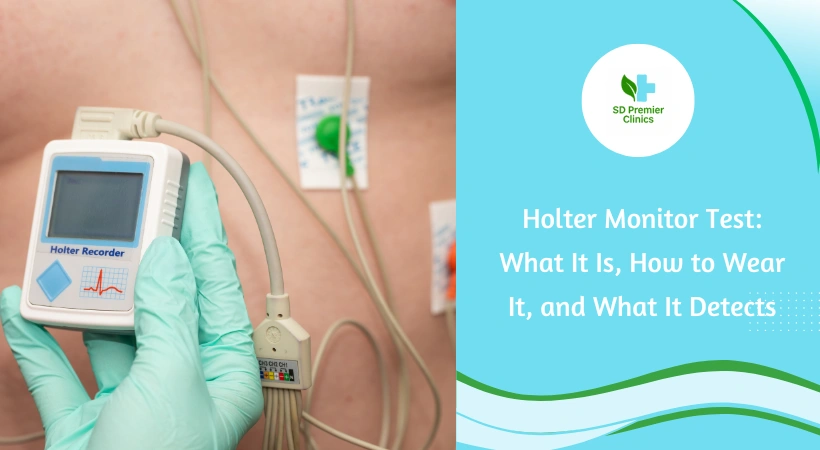
That's why cardiologists often recommend a Holter monitor. Think of it as an EKG that goes home with you. It records your heart's rhythm continuously for 24 to 48 hours while you go about your day.
If you've had ongoing heart symptoms, the cardiology team at SD Premier Clinics in San Diego, CA offers advanced diagnostic testing, including Holter monitoring.
Why Would a Doctor Order a Holter Monitor?
A normal EKG doesn't always mean your heart rhythm is normal. Many rhythm problems happen only occasionally.
Your doctor may recommend a Holter monitor if you have:
- Heart palpitations or a racing heartbeat
- Unexplained dizziness or fainting
- Shortness of breath without a clear cause
- Chest pain or tightness
- Symptoms that continue despite a normal EKG
- A new heart medication or pacemaker that needs monitoring
Sometimes the results simply provide peace of mind. Other times, they catch a problem early, so treatment can start sooner.
How Does a Holter Monitor Work?
A technician places small adhesive electrodes on your chest. These connect to a lightweight recorder worn on a belt clip, strap, or in your pocket.
Some newer monitors use a single patch instead of wires. Either way, the device only records your heart's electrical activity — it never sends electricity into your body, so there's no risk of shock.
Wearing Your Holter Monitor
Before your appointment, shower and skip lotions or oils on your chest. Wear loose, comfortable clothing. Fitting the device takes only a few minutes.
You'll wear the monitor for 24 to 48 hours, including while you sleep. Try to follow your normal routine — most people can keep working, walking, and doing light exercise.
While wearing it, avoid showering, swimming, and activities that cause heavy sweating. Stay away from MRI machines and strong magnetic fields, and keep your phone at least six inches away when possible.
Why Your Symptom Journal Matters
The monitor records every heartbeat, but it doesn't know how you feel. Your symptom journal fills that gap.
Whenever symptoms occur, write down what you felt, the exact time, and what you were doing. Note any anxiety or panic, too — it can temporarily raise your heart rate.
Your cardiologist compares this journal to your recording. Matching your symptoms to what your heart was doing at that moment often reveals answers a standard EKG can't.
What Can a Holter Monitor Detect?
A Holter monitor can help identify:
- Atrial fibrillation (AFib) — an irregular heartbeat linked to stroke risk
- Bradycardia (slow heart rate) and tachycardia (fast heart rate)
- Supraventricular tachycardia (SVT) — a fast rhythm starting in the heart's upper chambers
- Heart block — a delay in the heart's electrical signals
- Premature beats that cause a fluttering or skipped-beat feeling
- Rhythm-related dizziness or fainting

Some people have silent AFib — an irregular rhythm with no noticeable symptoms. It still raises stroke risk, so catching it matters even without symptoms.
If you've had a stroke or TIA (a brief, stroke-like episode), your cardiologist may recommend longer-term monitoring. A standard 24- to 48-hour test can miss infrequent AFib episodes in these cases. This follows guidance from the American College of Cardiology and American Heart Association.
A Holter monitor cannot detect blocked arteries, structural heart problems, or cholesterol levels. Your cardiologist may order an echocardiogram or stress test for a fuller picture.
After Your Test
Once you return the device, your cardiologist reviews the recording for abnormal rhythms or patterns. Your report includes your average, highest, and lowest heart rates, along with any irregular episodes.
At your follow-up, your cardiologist explains the results in plain language and discusses next steps. If your symptoms didn't occur during the test, a longer-term patch or event monitor may be recommended instead.
The Bottom Line
A Holter monitor gives your cardiologist a longer window to catch rhythm problems a standard EKG might miss. The test is safe, painless, and fits into your normal routine.
If you've had ongoing heart symptoms despite a normal EKG, don't wait. The cardiology team at SD Premier Clinics offers comprehensive evaluations, including Holter monitoring, to help find answers.
Ready to schedule? Request an appointment at SD Premier Clinics — new patients are typically seen within 1–2 weeks
Frequently Asked Questions About Holter Monitor Testing
1. Is a Holter monitor painful?
No. It's non-invasive and painless. Some people notice mild skin irritation from the electrodes.
2. Can I sleep while wearing it?
Yes. You'll wear it continuously, including overnight, so your rhythm is recorded around the clock.
3. Can it detect a heart attack?
No. It detects rhythm problems, not blocked arteries or heart damage. Other tests are used for those concerns.
4. How long until I get results?
Most patients hear back within a few days to a week, depending on how long review takes.
More Resources: