


Your doctor mentioned a pulmonary function test, and your first thought was probably, what does that actually involve? The name alone sounds clinical, and when you do not know what is being measured or what the results will tell you, it is easy to feel more anxious than you need to be.
The test itself is non-invasive, straightforward, and more informative than most diagnostic tools your doctor has access to.
Here is exactly what to expect and what the findings will tell you.
What Is a Pulmonary Function Test?
A pulmonary function test is not a single test; it is a group of non-invasive breathing assessments, each designed to measure a different aspect of how your lungs work.
Collectively, they evaluate three things:
- How much air your lungs can hold
- How quickly air moves in and out
- How efficiently oxygen crosses from the lungs into the bloodstream
No needles, no radiation, no hospital stay. The entire process takes place in a clinic setting and is guided step by step by a trained technician. PFTs are one of the most important diagnostic tools in pulmonary medicine; they can detect lung disease early, track how a condition is progressing, and measure how well a treatment is working over time.
Why Would a Doctor Order a PFT?
A PFT is typically ordered when symptoms point to a possible lung problem but the cause is not yet clear. Common reasons include:
- Unexplained shortness of breath or a chronic cough that has not resolved
- Suspected or confirmed asthma that needs to be better characterized
- Diagnosis and staging of COPD, particularly with a smoking or occupational exposure history
- Monitoring conditions such as pulmonary fibrosis or sarcoidosis over time
- Pre-surgical evaluation to assess lung capacity and anesthesia risk
- Evaluating the effects of long-term dust, chemical, or smoke exposure
- Routine monitoring for patients already on respiratory medications
The test helps pinpoint whether a problem originates in the airways, the lung tissue, or the transfer of oxygen into the blood, each of which points to a different set of conditions and treatment approaches.
Types of Tests Within a PFT
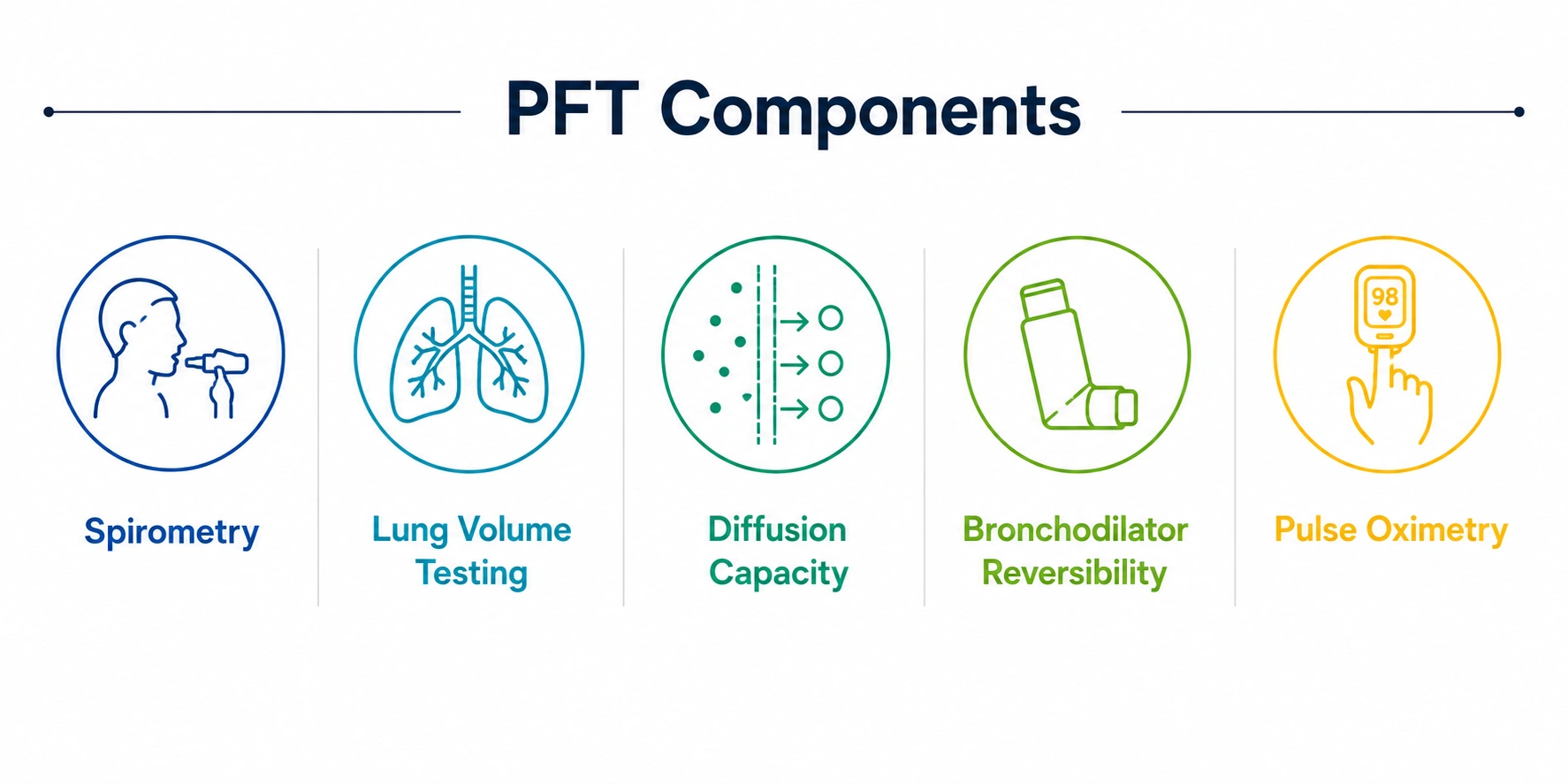
A PFT is not a single test, your provider selects the components most relevant to your symptoms and history. Here are the most common:
- Spirometry: The most frequently used component. You breathe forcefully into a mouthpiece, and the device records how much air you exhale and how quickly. The key values are FVC (total air exhaled), FEV1 (air pushed out in the first second), and the FEV1/FVC ratio, which is what distinguishes obstructive from restrictive lung disease.
- Lung Volume Testing: Measures everything inside the lungs, including air that stays behind after a full exhalation. Useful for detecting restrictive conditions where the lungs cannot fully expand.
- Diffusion Capacity (DLCO): Tests how efficiently oxygen crosses from the lungs into the bloodstream. A reduced DLCO can point to emphysema, pulmonary fibrosis, or pulmonary hypertension.
- Bronchodilator Reversibility Testing: Spirometry is repeated after inhaling a bronchodilator. Significant improvement suggests asthma rather than COPD, a distinction that directly shapes treatment.
- Pulse Oximetry: A simple clip on the finger that measures blood oxygen saturation, often performed before and after exertion.
What to Expect During the Test
Most appointments are completed in 30 to 60 minutes. A technician will walk you through each breathing maneuver and make sure you are comfortable before each step.
Before your appointment:
- Avoid smoking and strenuous exercise for several hours beforehand
- Hold certain inhalers as directed by your doctor
- Wear loose, comfortable clothing
- Avoid a heavy meal right before
The spirometry maneuvers require real effort, particularly the forced exhalation, and can feel tiring after a few attempts. They are not painful, but expect to rest briefly between rounds. The technician will coach your technique throughout, since effort and accuracy directly affect the quality of the results.
Afterward, your pulmonologist reviews the findings in the context of your age, height, sex, and ethnicity. This matters because predicted normal values are not universal, they are calculated from demographic reference data, and your results are measured against what is expected for someone with your profile specifically.
Understanding Your PFT Results
This is where most patients feel uncertain. Here is what the numbers actually mean.
Predicted vs. Actual Values
Every result is compared against a predicted normal value for someone of your age, height, sex, and ethnicity. Values at or above 80% of predicted are generally considered within normal range. Below that, the degree and pattern of impairment guide the diagnosis.
Obstructive Pattern
Characterized by a reduced FEV1/FVC ratio, typically below 0.70. Air flows out more slowly than expected, which points to narrowed or partially blocked airways. Conditions associated with an obstructive pattern include asthma, COPD, chronic bronchitis, and bronchiectasis.
Restrictive Pattern
Shows up as a reduced Total Lung Capacity. The airways are not blocked, but the lungs cannot fully expand. Causes include pulmonary fibrosis, obesity, neuromuscular disease, and pleural effusion. Spirometry ratios may appear relatively preserved, but the absolute volumes are low.
Mixed Pattern
Some patients show features of both obstruction and restriction simultaneously. This is more complex to interpret and typically requires specialist evaluation alongside additional imaging or testing.
Severity Classification
Results are classified as mild, moderate, severe, or very severe impairment. This guides treatment decisions and provides a baseline for tracking how the condition responds to therapy over time.
One important point: PFT results are never read in isolation. A board-certified pulmonologist interprets them alongside your symptoms, medical history, imaging, and any other relevant testing. The numbers give a picture, the specialist puts that picture in context.
What Happens After the Test
If your results are normal but symptoms persist, your doctor may recommend further evaluation, a CT scan, bronchoscopy, or cardiopulmonary exercise test, to look deeper.
If results are abnormal, a treatment plan is developed based on the findings. Depending on what is identified, this may include inhaled or oral medications, pulmonary rehabilitation, supplemental oxygen, or a combination. Repeat PFTs are scheduled at intervals to track how the lungs are responding over time.
Either way, you leave with a clear picture of what was found and a defined next step.
Protect Your Lung Health!
Lung problems rarely announce themselves until they are well established. A PFT catches what is happening before symptoms become impossible to ignore, measuring airflow, lung capacity, and oxygen transfer in a single, non-invasive session. The pulmonary function test results do not just confirm a diagnosis; they shape the entire treatment approach. Getting tested early, and understanding what the findings mean, can make a meaningful difference in long-term outcomes.
Breathe Easier with Expert Pulmonary Care at SD Premier Clinics
A pulmonary function test can reveal important insights about your lung health, but expert interpretation makes all the difference. At SD Premier Clinics, our pulmonology team provides advanced testing, clear explanations of your results, and personalized care to help you breathe with confidence.
Contact us to schedule your pulmonary function test or consultation today.
Frequently Asked Questions About Pulmonary Function Testing
1. What does a pulmonary function test measure?
A PFT measures how much air the lungs can hold, how fast air moves in and out, and how efficiently oxygen transfers into the bloodstream.
2. How do I prepare for a pulmonary function test?
Avoid smoking, heavy exercise, and certain inhalers for several hours before the test, wear comfortable clothing, and skip a large meal beforehand.
3. What do abnormal PFT results mean?
Abnormal results indicate some degree of lung function impairment, like the pattern (obstructive, restrictive, or mixed) helps your pulmonologist identify the underlying cause.
4. What is the difference between obstructive and restrictive lung disease?
Obstructive disease means narrowed or blocked airways make it hard to push air out; restrictive disease means the lungs cannot fully expand, reducing total air capacity.
5. When should you see a pulmonologist for breathing problems?
If you have unexplained shortness of breath, a chronic cough, wheezing, or gradually worsening symptoms, a pulmonary evaluation is worth pursuing sooner rather than later.
More Resources: