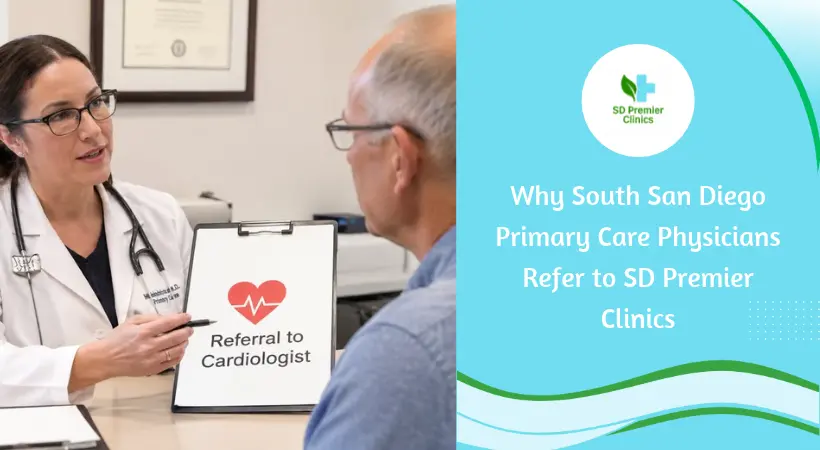
A referral is more than a phone number passed along. It’s a handoff, an act of trust that the patient’s care will continue in good hands once they walk out of your office. What happens next, how quickly they’re seen, how clearly findings come back, shapes whether that trust holds up over time. A smooth referral reflects well on the primary care office that made it.
SD Premier Clinics is a cardiology and pulmonary practice serving National City, El Centro, and the wider San Diego and Imperial County area.
Here’s what referring physicians typically look for in a specialty partner, how SD Premier approaches referrals, and what patients can expect once they arrive.
What Primary Care Physicians Look for in a Cardiology or Pulmonary Referral Partner
A few priorities tend to come up again and again when choosing where to refer:
- Timely access for patients who can’t afford to wait weeks for an answer.
- Clear communication back to the referring office, since primary care physicians are still managing the patient’s overall health.
- Diagnostics available without sending patients to multiple locations. A patient who has to schedule testing separately is more likely to delay or skip it.
- Experience with the conditions primary care sees most often, like hypertension, arrhythmia, and COPD.
- Staff who handle the paperwork, scheduling, and insurance steps, so the referral doesn’t stall before the patient is even seen.
- Convenience for patients in South San Diego and Imperial County, many of whom would otherwise face a longer drive to reach specialty care.
These aren’t abstract preferences. They’re the difference between a referral that resolves cleanly and one that leaves a patient stuck in the gap between two offices.
Two Specialties Under One Roof
Heart and lung symptoms overlap more often than patients expect. Shortness of breath, fatigue, chest tightness, and swelling can point to a cardiac issue, a pulmonary one, or both at once. A patient with COPD may also have underlying heart strain from years of reduced oxygen levels. A patient with heart failure may develop breathing difficulty that looks, at first glance, like a lung problem.
Having cardiology and pulmonary care in one practice reduces the back-and-forth that happens when the underlying cause isn’t obvious yet. Rather than referring out a second time and starting the evaluation over, the same practice can assess both possibilities in parallel.
Conditions commonly referred to SD Premier include high blood pressure, heart rhythm problems, coronary artery disease, heart failure, asthma, COPD, chronic cough, and sleep-related breathing concerns like sleep apnea.
When to Refer a Patient to a Cardiologist
A few signs point toward a cardiology referral specifically:
- Chest pain or pressure
- Palpitations or an irregular heartbeat
- Unexplained shortness of breath
- Leg swelling
- Fainting or near-fainting episodes
- Uncontrolled blood pressure despite treatment
- A strong family history of heart disease
Some of these are easy to attribute to something else, like stress or poor sleep, in a patient who otherwise seems well. When blood pressure resists standard treatment, or a patient reports palpitations that don’t show up during a routine office visit, that’s often where a specialist evaluation adds the most value.
Urgent symptoms, like sudden chest pain or fainting, need emergency care rather than a routine referral. A scheduled cardiology visit is appropriate once the immediate risk has been ruled out.
When to Refer a Patient to a Pulmonologist
Pulmonary referrals often follow a similar pattern of persistent, unresolved symptoms:
- A persistent cough that hasn’t improved
- Wheezing
- Ongoing breathlessness
- Abnormal findings on chest imaging
- Suspected sleep-disordered breathing
- Asthma or COPD that’s proving difficult to control
Many pulmonary referrals happen after first-line treatment hasn’t worked as expected: an inhaler that isn’t controlling symptoms, a cough that’s lingered past a typical respiratory illness, or imaging that raised a question the primary care office isn’t positioned to answer alone. That’s often the clearest signal that a specialist evaluation is the next step.
How the Referral Process Works at SD Premier
The process is designed to stay simple on the referring office’s end:
- The primary care office sends the referral.
- The SD Premier team contacts the patient directly to schedule the visit.
- Insurance and authorization steps are handled with the patient ahead of time.
- The patient is seen, with relevant tests completed as part of the same visit where possible.
- Findings and recommendations are sent back to the referring physician.
The goal is to keep the referring office’s involvement light. Once the referral is sent, the primary care team shouldn’t need to track down the patient or chase test results. That coordination happens on SD Premier’s end.
Keeping the Referring Physician in the Loop
Closing the loop matters for more than courtesy. It means fewer patients falling through the cracks, clearer follow-up on the primary care side, and better continuity between the specialist visit and the ongoing relationship. A referral that never reports back leaves the primary care physician managing a condition with incomplete information.
Referring offices can expect to receive visit notes, relevant test results, and treatment recommendations following the appointment. The goal is to work alongside the primary care relationship, not replace it.
Serving South San Diego and Imperial County Patients
SD Premier Clinics serves patients across National City, Chula Vista, and El Centro, along with surrounding communities throughout San Diego and Imperial County. For many patients, that means specialty cardiology and pulmonary care without a long drive to reach it, which matters more than it might seem. A patient who has to travel an hour or more for a specialist visit is more likely to delay scheduling it.
Whether a patient needs a cardiologist in San Diego or a cardiologist in Chula Vista, having two locations within the region keeps the referral practical for both the physician and the patient.
What Patients Can Expect After a Referral
Once a referral is sent, the first visit typically involves a review of your symptoms and medical history, along with any testing your cardiologist or pulmonologist recommends based on your specific situation.
It helps to bring a few things:
- Your referral paperwork, if you have it
- Your insurance card
- A current medication list
- Any prior test results or medical records
Having these on hand often means fewer follow-up calls and a faster path to a clear plan.
Your specialist and your primary care doctor will stay in communication throughout your care, so nothing gets lost between visits. You won’t need to relay test results or treatment updates back to your primary care office yourself.
Refer a Patient or Book Your Own Visit
For physicians: To send a referral, contact our office directly and our team will coordinate scheduling with your patient.
For patients: You can schedule your visit at either the National City or El Centro location by calling ahead or requesting an appointment online.
A delayed referral can mean a delayed diagnosis, and heart and lung conditions don’t always announce themselves loudly before they progress. Getting the referral moving quickly is usually the simplest way to stay ahead of that.
Frequently Asked Questions About Cardiology and Pulmonary Referrals
1. Do I need a referral to see a cardiologist at SD Premier Clinics?
It depends on your insurance plan. Some plans require one, while others allow direct scheduling, so it’s worth confirming with your insurer.
2. Can I see a pulmonologist without a referral?
In many cases, yes, though this also depends on your specific plan. Calling ahead to confirm is the most reliable way to know.
3. How do I know whether I need a cardiologist or a pulmonologist?
If you’re unsure, your primary care doctor can help determine which specialist fits your symptoms, and in some cases, both may be appropriate.
4. Will my primary care doctor get my results?
Yes. Visit notes and findings are shared back with your referring physician as part of standard follow-up.
5. How quickly can I get an appointment?
New patients are typically seen within 1 to 2 weeks of the referral being sent.
More Resources:
- 7 Warning Signs Your Heart Is Trying to Tell You Something
- Heart Failure: What It Is, What It Isn't, and How to Manage It
- Heart Palpitations: Causes and When to Worry